J. E. STONE
April 22, 2026
Like most states, Tennessee schools are overloaded with economically disadvantaged children and thus in need of highly effective teachers, i.e., teachers who produce above-average achievement growth–especially in preK-3. Without such teachers, disadvantaged kids typically start behind and stay behind.
The good news is that there are schools throughout the country that train the teachers they hire to become highly effective. Steubenville, OH is a prime example. Over 80% of their students are economically disadvantaged but all learn to read well by third grade. Nationally, only about 1/3 of all students reach that benchmark.
So, how does Steubenville do it? They make sure that their teachers are trained in effective practices, and they systematically track the results. Success for All is the district’s choice for the all-important early reading instruction; and by taking the same approach year after year, Steubenville ensures that virtually all students, including those labeled disadvantaged, stay on track for 3rd grade proficiency.
So, why aren’t more schools doing the same? The primary reason is that few districts are as careful as Steubenville about ensuring the effectiveness of their reading instruction. Most rely primarily on the training teachers get from their teacher preparation–programs that are typically inconsistent, unaccountable, and antagonistic toward packaged programs like Success for All.
Data published by the Tennessee Department of Education (TDOE) illustrates the problem.
Tennessee was the first state to adopt “value-added assessment” of student achievement and use it to evaluate teacher preparation programs. Tennessee’s Value-Added Assessment System (TVAAS) is a sophisticated statistical tool that can make fair comparisons of the achievement gains earned by students who have been taught by different teachers.
TVAAS uses the same data to assess the quality of teacher training programs. In the jargon of Tennessee’s teacher preparation report card, the achievement gains produced by teachers who were trained by a given program are reported on a five point scale: 1-2 = “below expectations,” 4-5 = “above expectations,” and 3 = “at expectations.”
Students taught by a teacher rated 4-5 might grow by 1½ or 2 years in a single school year. Students taught by a teacher rated 1-2 might grow by only a half year in the same period of time. Students with a teacher rated 3 would grow only by one year’s worth of achievement per school year.
For schools with disadvantaged majorities to be as successful as Steubenville, they would have to hire teachers rated 4-5 almost exclusively. The use of teachers rated 3 or lower would result in disadvantaged students remaining below grade level or falling further behind.
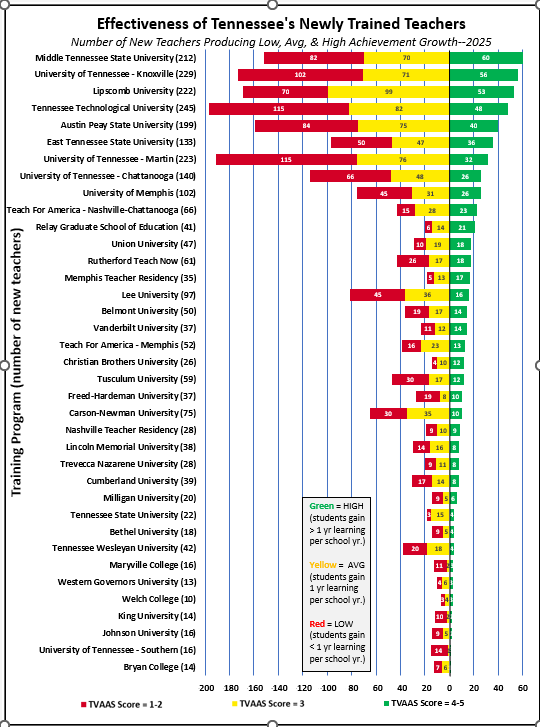
As per the graphic below, the TVAAS results for the graduates of the state’s teacher preparation programs are indicated as follows: “HIGH” (green) refers to “highly effective” teachers, “LOW” (red) refers to “highly ineffective” teachers, and “AVG” (yellow) refers to “average” teachers–ones who are producing one year of growth per school year.
In summary, of Tennessee’s 2722 new teachers with TVAAS-based effectiveness ratings, 641 were rated effective or highly effective but 1113 were rated ineffective or highly ineffective. That’s 12 ineffective teachers for every 7 that are highly effective. The remaining 968 were rated as average.
Of Tennessee’s 37 teacher preparation programs with enough graduates to be included in the state report card, only 7 produced more highly effective than highly ineffective teachers.
Plainly, Tennessee’s teacher preparation programs produce far too few highly effective teachers and an unacceptably high number of highly ineffective teachers. In truth, one wonders whether these teachers should have been graduated, much less licensed by the state and hired by a school district.
Implications: For Tennessee to significantly improve its educational outcomes, the state’s teacher preparation programs will have to place greater emphasis on effective teaching and a set higher minimum standard for their graduates.
Other states confronted with large numbers of disadvantaged students may need to consider similar measures.